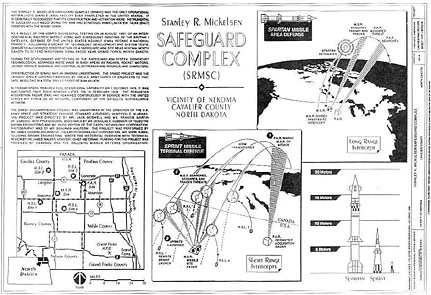
As America's only nuclear anti-ballistic missile site neared full operational capability in September 1975, the installation represented a massive investment in
technology - but there was a question often asked about the system - Would it have actually worked?
Twenty years of design and testing yielded a generally capable system. The Data Processing System (DPS) was state of the art at the time, and could handle up to 10 million
instructions per second (although by 1976, commercial computers could handle twice that amount). The Missile Site Radar and Perimeter Acquisition Radar phased-array radar systems
were electronically steered so that many targets could be detected and monitored at one time. The MSR radar also had a shorter-range tracking capability, but also used the radar
faces to direct interceptor missiles against incoming re-entry vehicles. The automation of the system merely required activation via the human-controlled launch enable sets
(to comply with nuclear surety rules) before the DPS computers tracked targets and assigned interceptor missiles to destroy them.
In regard to electromagnetic pulse (EMP) vulnerabilities, the sites were built with vast protection measures against the phenomena and were tested before they went operational.
The missiles too utilized EMP hardening techniques. There is considerable documentation about the nuclear hardening program in
Chapter 6 of ABM Research and Development at Bell Laboratories: Project History.
In regard to nuclear blackout, in which the fireball of an exploding nuclear weapon blocks or absorbs the radar beams from the PAR or MSR (blinding the radar), the PAR was
upgraded during the Nike-X program from a VHF to UHF capability - which was generally thought to be more resilient to nuclear effects. The MSR radars meanwhile operated on the S-band,
what today is referred to as a "goldilocks zone" of effective range but also effective discrimination against targets. Spartan missiles possessed W71 warheads that minimized
the creation of fission products at high altitude (a so-called "clean" warhead) to minimize the effects of nuclear blackout to the PAR and MSR radars. Sprint meanwhile would
conduct an intercept and burst at low enough altitude and with low enough yield to the point that nuclear blackout would be less of a problem to search radars (although the problem
was not totally eliminated).
The problem with Safeguard, as well as with other ABM systems, was that it was difficult to make "defense" as cost effective as "offense" in terms of intercontinental
ballistic missiles. Numerous offensive missiles could overwhelm a defensive system at lower cost, and the addition of relatively cheap multiple independently targetable re-entry vehicles
made a difficult defense mission potentially impossible. With only one hundred interceptor missiles available, an attack with 101 warheads would mean at least one warhead would get
through - a case made against city defenses for the earlier Nike-X and Sentinel. Thus, there was a worry that ABM systems would ironically not make the world a safer place - but
instead encourage a continuation of the arms race. Further, nuclear blackout vulnerabilities were mitigated - but they were never eliminated for Safeguard.
In terms of politics, Safeguard was seen by detractors as an overly expensive and less-than-effective system. During the post-Vietnam War drawdown, it continued to draw backlash
with eventually successful calls for deactivation.
In the end, a point was made less about the "tactical" effectiveness of Safeguard and more of its political nature. It was considered a "bargaining chip" during
the Strategic Arms Limitation Talks from 1969 onward - and negotiations between the Soviet Union and United States resulted in a treaty in 1972. A Soviet counterpart to Safeguard,
as a replacement for a very troubled early ABM system around Moscow, only entered operational service in the 1990s. The United States meanwhile ultimately ended the Safeguard program
in 1976, although ABM studies continued.
Norman R. Augustine, Undersecretary of the Army, summed things up at a ceremony for the 1974 Effective Readiness Date - "The benefits are in terms of peace for people throughout
the world, that's the payoff"
Sources: