In two concurrent ceremonies 44 years ago on Sept. 27, 1974, at the Missile Site Radar Complex near Nekoma, North Dakota, and at the Ballistic Missile Defense Center located in the NORAD
Cheyenne Mountain Complex, near Colorado Springs, Colorado, representatives of Western Electric Company officially transferred the Safeguard facilities to the U.S. Army Ballistic Missile Defense
Systems Command.
This transfer signaled the end of the construction and installation phases meeting a milestone established four and half years earlier.
In Colorado Springs, Col. D.E. Mulligan, representing the BMDSCOM commander, accepted the BMDC from J.B. Bocock, the Safeguard System general manager, Western Electric Company.
Western Electric Company was the Prime Weapon System Contractor for the entire Safeguard program. Following the signing of the acceptance documentation by the two on-site leaders
Lt. Col. L.A. McIntyre, commander, Safeguard Command -- BMDC, and D.F. Littlefield, the BMDC site manager for WECO, Mulligan turned over the BMDC to McIntyre.
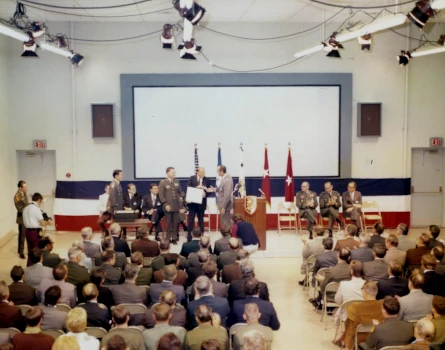
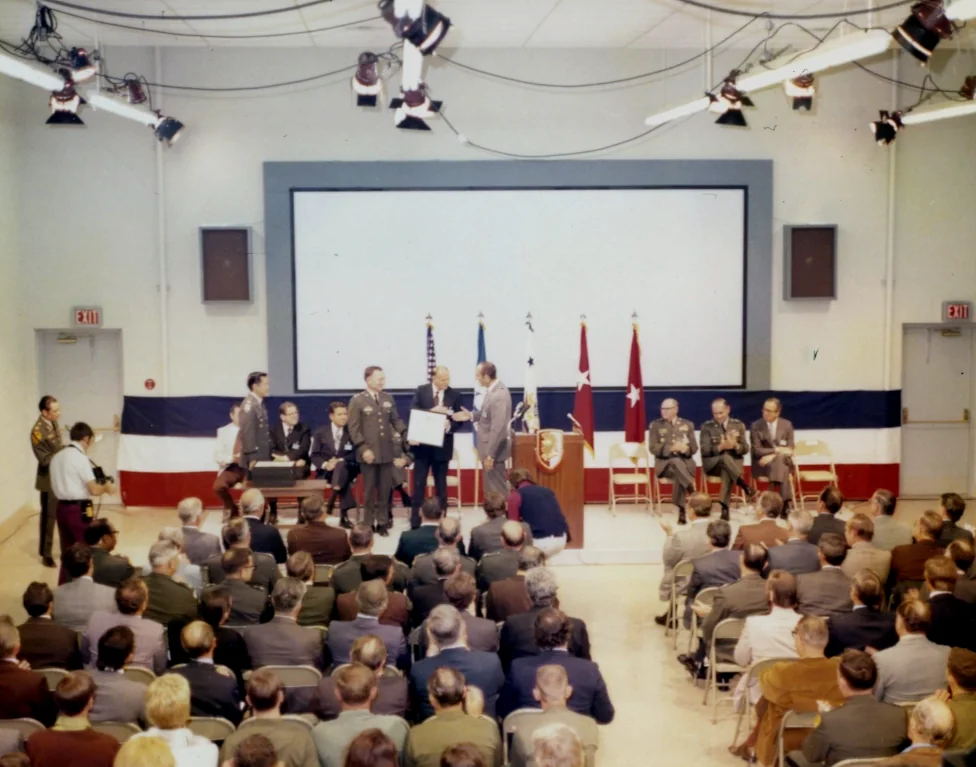
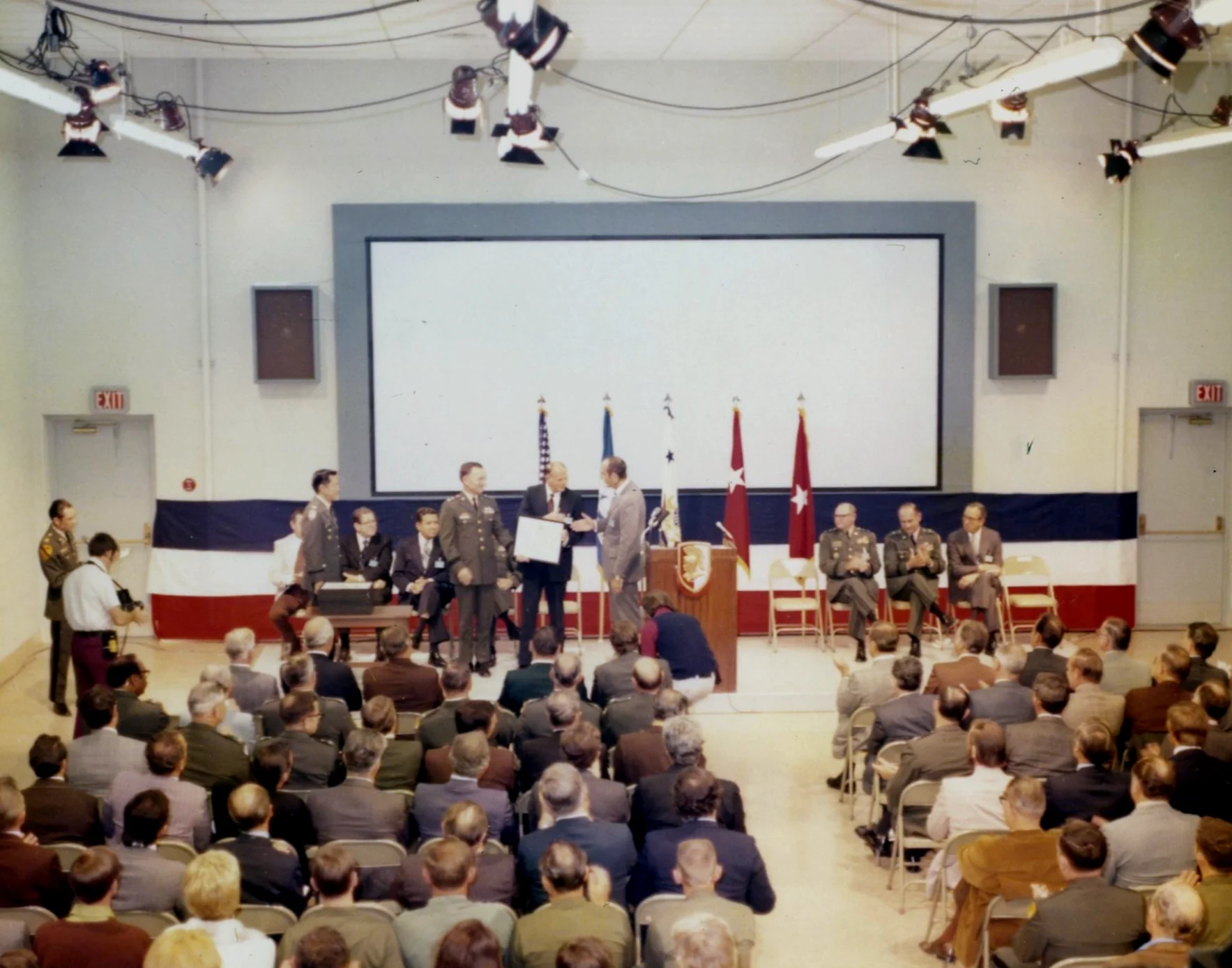
In a similar ceremony, before a filled auditorium of government and contractor personnel, with each aspect documented in still photographs and film, William L. Opdyke, vice president,
Government Systems, Western Electric Company, presented the completed Safeguard System tactical complex - the only missile defense site in the free world - to Maj. Gen. Bates C. Burnell,
commander, BMDSCOM.
Burnell in turn transferred the Safeguard Complex to Brig. Gen. Robert M. Mullens, commander, U.S. Army Safeguard Command. During the subsequent signing ceremony, S.C. McDonald,
WECO site manager, and Robert P. Wilson, Comptroller Government Systems Division, WECO, signed a document signifying the completion of the facilities and contractually turned the BMD
System over to the government representative, William O Turney, chief, BMDSCOM Contracts Office.
At this point Maj. Gen. Robert C. Marshall, the BMD program manager, and Norman Augustine, assistant secretary of the Army (Research and Development), presented Department of the Army
Certificates of Appreciation for Patriotic Civilian Service to a dozen of the key organizations that contributed toward this achievement. The companies recognized for their long-term
dedication and significant contributions to the Safeguard System were:
-
Western Electric Company as the primary weapon system contractor
-
Bell Laboratories for system design and integration
-
General Electric Company for Perimeter Acquisition Radar development and production
-
Raytheon for Missile Site Radar development and production
-
McDonnell-Douglas Astronautics Company for Spartan missile development and production
-
Martin Marietta Corporation for Sprint missile development and production
-
International Business Machines for software development
-
Morrison-Knudsen Company as the major construction contractor
-
American Telephone and Telegraph Company as the common carrier for tactical intersite communications
-
Polar Rural Telephone Mutual Aid Corporation as the common carrier for Safeguard communications subsystems
-
Grand Forks Building and Construction Trades Council's construction workers
-
Communications Workers of America, Local No 7290's equipment installation workers
Augustine described the Safeguard system as a significant success "[representing] in terms of enormity and difficulty of technical challenge one of the three or four most demanding
undertakings in history." Adding that, "the construction alone was represented by the largest dollar contract awarded at that time in the history of the Corps of Engineers."
And he commended the employees on the timeliness of their efforts, "hitting the mark, as you have done, is almost without precedence" especially given the issues of "inflation, materiel
shortages, and the host of other problems which had to be dealt with."
Augustine cited three factors that led to this success. First, a clearly defined goal. Second, a realistic assessment of the tasks --both with regards to the schedule and the resources.
The third ingredient was the "gathering together of an extremely talented and conscientious team to tackle the job."
As one source observed, during the height of the Safeguard effort, between 1970 and 1973, there were 10,000 professionals involved in the design development, to include 2,000 computer programmers.
At the same time, technological breakthroughs in construction were achieved in an environment in which temperatures ranged from -40°F to 100°F.
In his conclusion, contemplating the costs to develop and construct this system, Augustine asked "Was it worth it? Will it pay off?" First, he observed that the nation will gain invaluable
experience in BMD operations from the Safeguard System. Second, he added that technological advances and spin-off technologies will benefit both the military and the nation. Third, the Safeguard
program was influential in the negotiations that produced the Anti-Ballistic Missile Treaty and the Interim Offensive agreements. Finally Augustine concluded "the benefits in terms of peace
for people throughout the world are the real payoff."
A buffet luncheon and a tour of the facilities followed the ceremony.
Design work for the Safeguard System Complex began in 1968. The initial ground breaking occurred in 1970. The test period began in September 1973 and concluded with the equipment readiness date.
Four and half years after the initial contracts were signed, the completed facility was turned over to the government, three days ahead of schedule.
Sources: