Construction on the $137 million SAFEGUARD anti-ballistic missile complex in North Dakota began following a quiet ground-breaking ceremony on April 6, 1970, near Concrete, N.D. One month later,
ground preparations at the Missile Site Radar, or MSR, site near Nekoma, N.D., were temporarily stopped as Army and contractor personnel prepared for International ABM Day.
In 1970, the national climate was tense. Protests were held across the country against social injustice and the war in Vietnam. The situation in North Dakota was not much different.
Even as the residents of Cavalier and neighboring counties planned their VFW Loyalty Day event for May 2, opposition groups issued their own resolution.
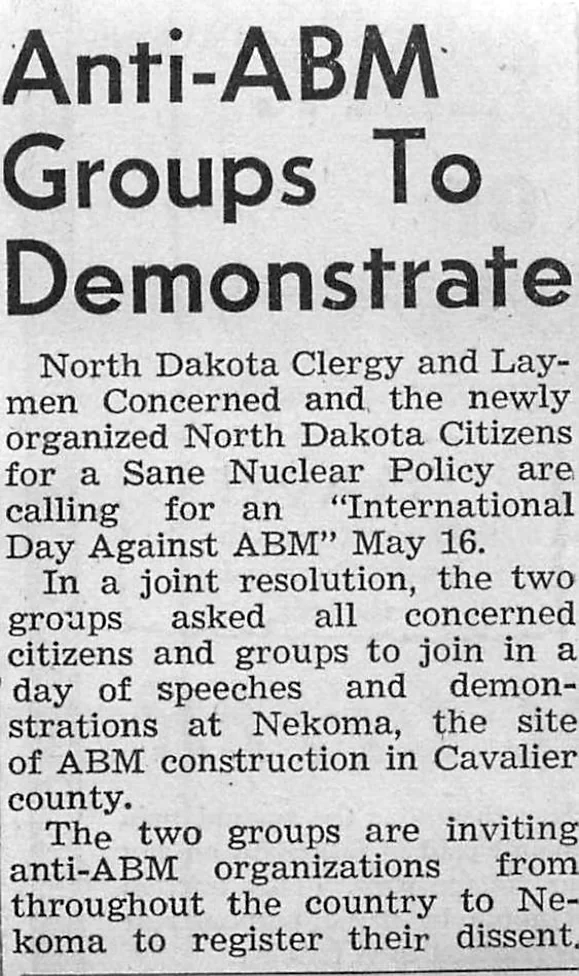
On April 19, the North Dakota Clergy and Laymen Concerned, and a recently formed North Dakota Citizens for a Sane Nuclear Policy, called for an International Day Against the ABM, later abbreviated to
International ABM Day, to be hosted on May 16. With rallying points on the Grand Forks campus of the University of North Dakota and the construction site for the MSR near Nekoma, the
protesters sought to "to register our dissent and re-order national priorities" expressing "hopes that the administration and Congress will be forced by their conscience to stop deployment
of the ABM System and present its further expansion."
As preparations continued, press conferences announced that "several nationally-known liberal activists" had agreed to participate in the demonstrations, including David Dellinger and John Froines, two
members of the Chicago 7, and revolutionary folk singer Phil Ochs. With thousands expected to attend from the five-state area, the spokesperson suggested it would be "the largest political
protest ever staged in North Dakota."
Given recent events at Kent State and the anticipated national protests on May 15 (Armed Forces Day), the residents of Nekoma, with a population of 87, were concerned. The town of Zap, N.D.,
had been extensively damaged following the "Zap In" protest of May 1969.
As a precaution, Mayor William Verway directed that all businesses in Nekoma be closed on this Saturday. To protect the small villages in the area, Verway and others also contacted
the governor for assistance. Although he sympathized with the protesters, Governor William Guy assured the communities that the North Dakota Highway Patrol and the National Guard would be alerted.
As projected numbers swelled, there was conjecture that new groups that might advocate "inflammatory and destructive tactics" now controlled the protest. Following a lengthy meeting
with the National Guard and the Highway Patrol, Governor Guy placed the guard on "strategic weekend drill status." At the same time, he advised President Richard Nixon
that the defense of the ABM site was a federal responsibility.
Law enforcement personnel also met with protest leaders to set ground rules and help keep the demonstration peaceful. A specific site on the property was identified for the protest that
would be marked but unfenced. The site was not immediately adjacent to the construction site, described by several as a mountain of dirt and a "monstrous hole" about 40 to 50 feet
deep. For the Corps of Engineers it was to be business-as-usual with men and machines continuing with site preparation up until the actual day. Officials would however provide latrines
and a trailer from which speakers could address the crowd.
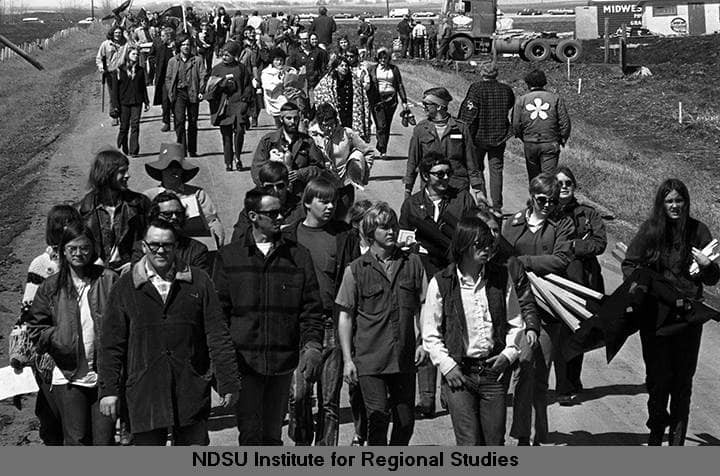
The actual events at the Nekoma "Festival of Life and Love" were rather quiet. As the Grand Forks Herald reported "Members of the press, several North Dakota newspapers, a
Minneapolis paper, all of the local television stations and a crew from CBS waited for something to happen. It didn’t."
The highway patrol blocked access to Nekoma and provided traffic control as a caravan of more than 100 cars and buses arrived from Grand Forks and elsewhere. A crowd of
about 2,000 spent the day making their way through a sea of mud created by three inches of rain that had fallen in the days previous.
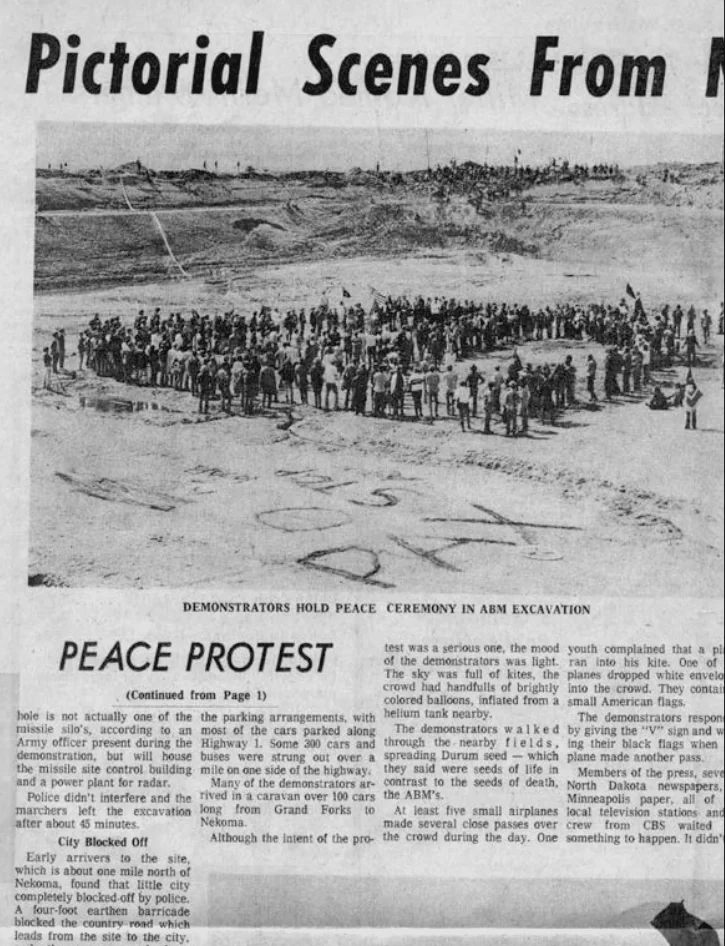
The atmosphere was compared to a picnic as attendees, sitting on sheets of plastic, enjoyed their lunches while listening to speeches and music. The festivities also included
kite flying, balloon releases and the planting of durum ("seeds of life") and flowers.
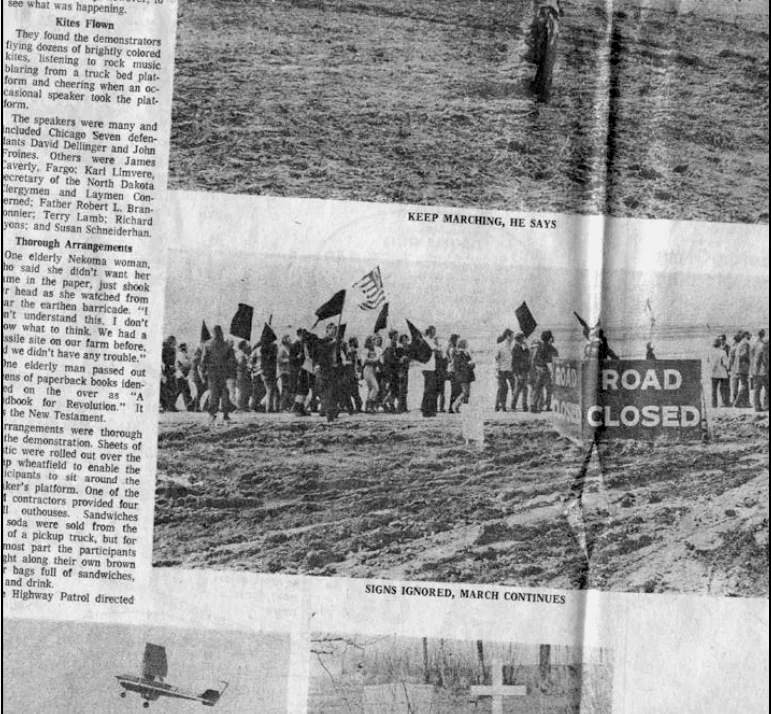
The most dramatic incident came later in the afternoon, as a small group of approximately 250 protesters moved toward the construction site. Marching to "The Battle Hymn
of the Republic" played on kazoos, demonstrators passed the "Road Closed" and "No Trespassing" signs to enter the excavation site for the Missile Site Radar. While some of
the demonstrators planted more durum seeds and ash trees, others buried a tomahawk and smoked a peace pipe. A group of the protesters removed the surveying markings and
wooden molds using them to create peace signs, etc. in the mud. The crowd gradually dispersed and by 6 p.m., the site was empty.
The Corps of Engineers estimated damages to the site were minimal, less than $1,000 and a day’s work at the site. The history of the Huntsville division noted that "about the only
damage done was the uprooting of forms in the bottom of the MSR excavation and the need to re-do some final grading disturbed by the passage of privately owned vehicles."
Work resumed on the MSR site, which was completed on schedule, and no other anti-ABM protests were noted in histories.
Additional Articles
Additional Photos
-
D405, D406: Clippings from an unknown newspaper.
-
C009: Clipping from the Cavalier Chronicle.
Sources:
-
Articles:
-
Photos:
-
Cnnn: Cavalier Chronicle
-
Dnnn: SMDC (Space & Missile Defense Command)
-
Nnnn: NDSU / Dave Machacek via Facebook (2)