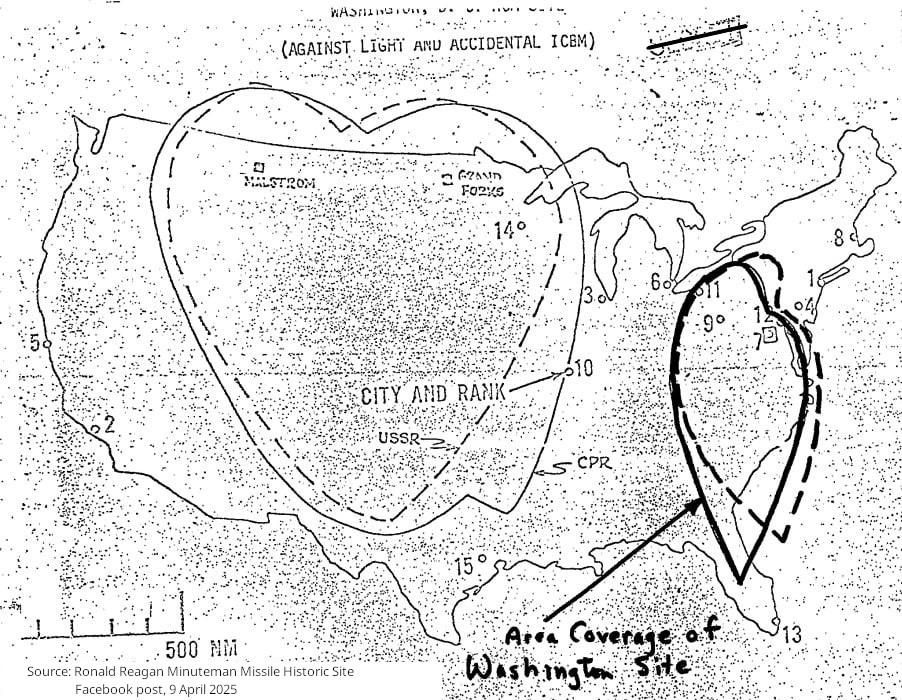
 Safeguard protection of population centers (Click photo for larger image) (R050)
1975-2025 - 50 Years After
The Stanley R. Mickelsen Safeguard Complex in North Dakota
Ronald Reagan Minuteman Missile State Historic Site
Facebook post, 9 April 2025
As the Stanley R. Mickelsen Safeguard Complex became operational in April 1975, its complement of long-range Spartan missiles actually provided a reasonable defense-in-depth
of the American heartland (as far south as Texas) as evidenced by the map above. Those missiles were intended to intercept Soviet or Chinese re-entry vehicles near 300 miles
altitude in the exosphere, and required precise targeting via the Data Processing System (DPS) located within and below the Missile Site Radar pyramid. The 5 megaton punch
of the Spartan's thermonuclear warhead was intended to destroy the incoming re-entry vehicle by blast or by powerful x-ray emissions.
30 Spartans were ultimately deployed at the MSR complex just north of Nekoma, North Dakota alongside 16 shorter-ranged and low-kiloton yield Sprint missiles intended to
destroy enemy re-entry vehicles that had escaped destruction by the Spartans. The remaining 54 Sprints were divided among four Remote Sprint Launcher complexes surrounding
the Langdon, North Dakota area - an area also occupied by the 446th Strategic Missile Squadron (Minuteman) assigned to Grand Forks Air Force Base.
The deployment of the Safeguard system was initially intended to offer a credible defense of American Minuteman missile silos against increasingly accurate Soviet
intercontinental ballistic missiles (ICBMs), and therefore strengthening deterrence against a first strike. Construction also began at a site north of Malmstrom AFB
in Montana but work was abandoned in 1972 after the signing of the ABM treaty (in which only a single ICBM defense site was authorized), and projected sites near F.E. Warren
AFB in Wyoming and Whiteman AFB in Missouri were never built. Only the Grand Forks installation would briefly come to operational status between April 1975 and February 1976.
(Note the smaller proposed Washington D.C. defense area on the map, probably due to the fact that it was at one time programed for a MSR, but not a long-range Perimeter Acquisition
Radar (PAR) that would provide earlier warning of inbound re-entry vehicles and earlier intercepts by Spartans. Both the Malmstrom and Grand Forks sites were to be equipped with PARs,
and only the one in North Dakota was completed. In 2025, the Grand Forks PAR continues to operate as a part of Cavalier Space Force Station.)
Sources:
-
Post from Ronald Reagan Minuteman Missile State Historic Site via Facebook (4)