Chief Operations Sergeant in the MSR's BMDOC (Ballistic Missile Defense Operations Center)
 1 January 2004, Elizabethtown, KY
Guestbook Entry
1 January 2004, Elizabethtown, KY
Guestbook Entry
General Weather Security MSR / BMDOC Operations BMDOC Q & A
General I arrived at the MSR in early August, 1974. I had just returned to CONUS after a tour as a First Sergeant on a HAWK site in Germany. After believing that the area would be cold, we were surprised at how hot it was. We had to go to Grand Forks to get an air conditioner for the quarters. Several weeks later, it went to zero and stayed that way. We moved into quarters 33A on 9th street. They had been previously occupied by one of the contractors during site construction. I was slotted to be the First Sergeant at the PAR, but that slot was eliminated before we even became organized, and I was slotted into the Chief Operations position in the Ballistic Missile Defense Operations Center (BMDOC). I was reunited with many old friends in Nekoma. CW3 Black, mentioned in your personnel list, was an old friend, as was MAJ Tom Gallagher, CWO Clint Eskilsen, MAJ Mike Moralles, and several others. We had all spent time together on one site or another. That was the last Air Defense assignment I had, and after that assignment, the Army ceased to be fun. (Back to top)
Weather The down side to duty at SRM was the weather. To this day, I get the weather report from Nekoma and remind my wife how much better it is in Kentucky than North Dakota. We had a "blizzard of the Century" in January, 1975. I had crews snowed in at the MSR for three days (remember, the whole site was a complex only about a square mile). The wind blew so hard that snow was blown inside of vehicles which were left out in the elements. We were days getting everything operational again. My son had gone to a basketball game in Nekoma the evening the storm started. I went to get him and the blizzard started while I waited. It was snowing so hard that it took us several hours to navigate the short distance home from Nekoma, less than 2 miles I think. Strange things happened to equipment in the cold. Metal parts would on occasion just break off. You always carried your "Emergency Kit" in the car in case you got stranded, and many people did. (Back to top)
Security We all wore badges, which were exchanged as you went between areas. As I remember, the general badge, worn outside any restricted area, was green, or sort of OD in color. The badge you got inside the BMDOC was pink. You got these badges as you went through check points which were manned by security. Badges had a set of letters which denoted which areas the individual was authorized to be in, as well as designating those who were authorized to be escorts. Visitors got a temporary badge and had to be escorted at all times. I, for instance, was authorized to be in all areas, and was an escort. All Army personnel involved with Nuke weapons had to be members of the PRP (Personal Reliability Program). The Air Force equivalent of the PRP was the Human Reliability Program, or HRP. Since our next higher command was NORAD, an Air Force agency, we had to be members of both systems. This involved very extensive background checks and periodic psychiatric checks. Any doubt about a person's stability and they were out of the PRP, and could not be in the restricted area. There were two types of PRP, Critical and Control. Members of the Critical PRP were those personnel who had access to the actual weapon or who could release the weapon. BMDOC personnel were all members of the Critical PRP. Control PRP were those personnel who controlled access to the weapon; the guards. Anyone in the Critical PRP had to be temporarily removed from the PRP if anything happened which could affect their judgment. Any medication stronger than aspirin would cause removal, for instance. I was the PRP administrator in the BMDOC, and on one occasion I had to remove General Mullins from the PRP because he was on medication. Stranger yet, I had to take myself out of the PRP for the same reason on one occasion. (Back to top)
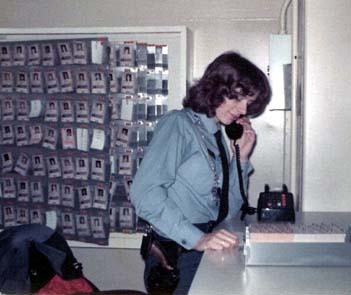
MSR / BMDOC Operations Life at the MSR was about as good as it got in Air Defense. As an old "muddy boot" soldier, I was amazed at the facilities and working conditions there. I had never had it so good. We rarely worked beyond a normal duty day. I had been on many gun and missile sites for around 20 years by the time I got to Nekoma, and Safeguard was the first site I ever saw which was up to strength, had all the crews authorized, and where the troops actually got the time off they were supposed to. Also, the quality of soldier stationed at the MSR was better than any I had ever seen. Everyone was screened and checked very thoroughly prior to being sent to Safeguard, and most were volunteers. We had some personnel problems of course, but not nearly as many as you would expect from a population that size in an isolated environment. The hunting and fishing were great, a sportsman could always find something to do (I never caught on to ice fishing though). We were constantly giving VIP tours. I can personally remember escorting The Army Chief of Staff, NORAD Commander, Secretary of State, Secretary of Defense, many senators and congressmen, The Chief of Chaplains, and many other high ranking dignitaries through the building. For a while, we had a sign over my office door which said "Pyramid Tours" on it with a picture of the MSR. The Colonel made us take it down. By the way, Chaplain Gunus, who was our chaplain, is now the Army Chief of Chaplains, I think he is a LT General. The BMDOC was located right in the center of the MSR. One had to go through 2 badge exchanges, have a TS clearance, and be a member of the PRP in order to get in there without an escort. I worked for COL John House, who was the BMDOC commander, and the Deputy Commander for Operations on the site for the first year. He later went to Belgium and was replaced by COL Bill Walker, who I worked for until we deactivated in 1976. There were 5 crews assigned to the BMDOC. Each crew consisted of a Tactical Director (LTC), an Assistant Tactical director (MAJ), A Missile Officer (MAJ), A Maintenance Officer, ( CPT), an Operations SGT (SSG or SFC), and an Exercise Officer (MAJ). The exercise officer ran canned tactical missions against the crew on duty for training and testing purposes. The idea was that three crews would be in manning rotation, one crew would be off, and one crew would be in training. We later found that a crew could train while it was on manning, so the 5th crew became the Operations Section to handle the ongoing projects which kept coming our way from HQ. The commander, either General Mullins or one of the Deputy Commanders, and I overwatched activities in the BMDOC on the commander's console, and the commander issued commands as to priorities, engagement enablement ,etc. I ran the commo console in these instances. We were on different PRP teams as required, since under the rules, if the Commander determined that an otherwise unauthorized firing should take place, I had to agree with him or that could not happen. More BMDOC photos
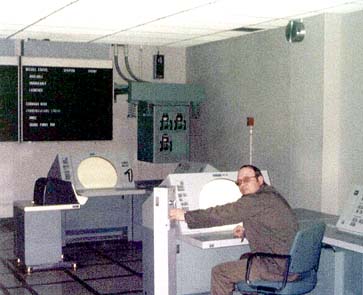
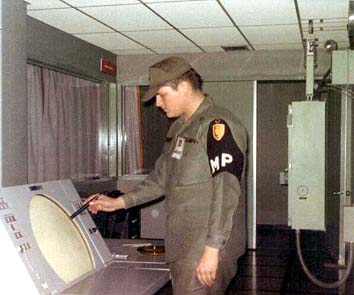
(each gallery opens in a new window) (Back to top)
BMDOC Q & A
- At the beginning of an engagement (drill), the system must have changed from "surveillance" mode to "battle" mode. Was there some kind of indication that this occurred? Flashing lights? Alarms or sirens?
- System status was displayed on the "flapper" board at the front of the BMDOC, and on the operator's consoles. The world outside that area would have not known (until the first bang).
-
How was the system set to "exercise" mode versus "live" mode? - The exercise officer, who was in a different room, set the exercise mode. The computer system had a lot of redundant capability, and when all was well, you could split it in half and use part of it as the attacking force, sort of like a giant computer game. They had tapes with different scenarios on them which they ran to simulate attacks in order to provide crew training. The system would automatically override the training mode should some sort of actual situation occur.
-
Were the nuclear enablement keys in the "enable" mode most of the time, or was this done only during a drill? Did the system in some way request this nuclear enablement? - NO and NO!! The enable keys were ONLY enabled when the two operators involved both determined that a missile should be fired. The sequence was quite involved, but suffice it to say that firing was authorized when two members of the Critical PRP, on different teams (1 Red and 1 Yellow) , having received the information through different channels, both determined that firing was justified under the rules of engagement. They both then unlocked the controls and turned their handles simultaneously. This was actually an emergency method used only when the automatic system was out. If the automatic system was working, authorization was transmitted electronically through secure commo and firing was largely automatic, having been authorized at higher headquarters.
-
Was there an indication that the system had launched (simulated) intercepter missiles? - The system told you when it had fired, the type of missile, and where from. This was displayed on the flapper board and the consoles.
-
Were there different indications for Spartan and Sprint launches? - Yes, the system told you what it had fired.
-
For Sprint, was there an indication of whether it launched from the MSR complex or one of the RSL's? - Yes, you knew where the missile came from.
-
What was displayed on the scopes during a drill? - Space War stuff. At the PAR, you did see a large map of North America and trajectories of incoming missiles, along with impact coordinates and time. At the MSR, what you had were printed information and command options, which were enabled by using a light pen. No fancy graphics at the MSR, all printed material, regarding the number of incomings, their destinations, time to impact, action taken, etc.
-
Were successful "kills" (or misses) indicated in some way? - The operators knew the outcomes of engagements. The system told them.
-
Was there an indication that the engagement (drill) had terminated and the system was returning to "surveillance" mode? - In most drills, after you had expended all available rounds, a final incoming would be targeted on the MSR, and all you could do was wait for it to hit. A nice way of keeping us humble I guess.